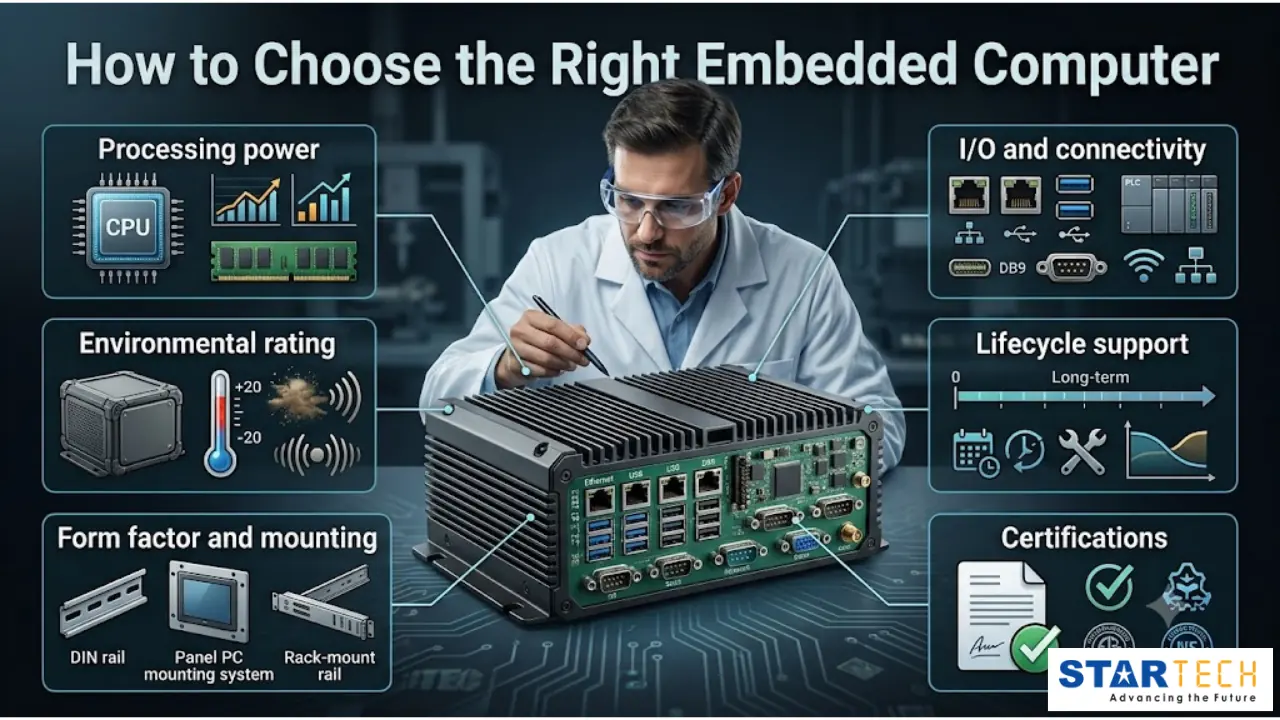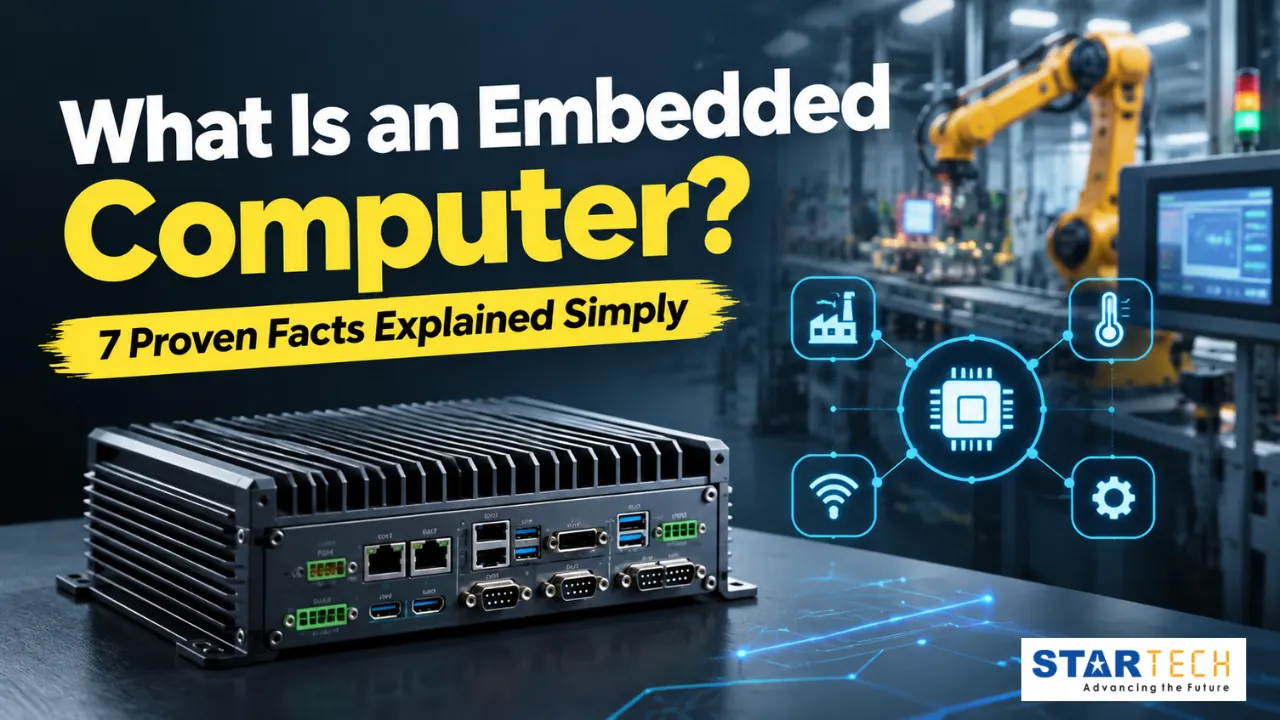
So, what is an embedded computer at its core? Think of it as a specialist, not a generalist: a processor, memory, and I/O selected specifically for the one job it needs to do — running a factory controller, powering a digital kiosk, managing a building’s HVAC system, or processing sensor data at the network edge — rather than the broad, everyday computing a laptop or desktop is built for.
The defining trait of an embedded computer isn’t its size, though most are compact. It’s dedication. Every design decision — the processor chosen, the I/O included, the operating temperature it’s rated for — is made in service of one application, which is exactly what makes these systems so reliable in industrial settings where a standard PC would fail.
Here’s where most explanations get confusing: people use “embedded computer” and “embedded system” interchangeably, but they’re not quite the same thing. So, what is embedded system exactly? An embedded system is the complete, deployed solution — the embedded computer itself, plus the sensors, software, interfaces, and mechanical housing it’s paired with to perform a dedicated task inside a larger product.
Put another way: the embedded computer is the engine. The embedded system is the whole vehicle. Every embedded system depends on an embedded computer to function, but not every embedded computer is sold or deployed as part of a fully packaged embedded system — many are supplied as standalone units that integrators build into their own solutions.
| Aspect | Embedded Computer | Embedded System |
|---|---|---|
| Scope | The processing hardware itself | The complete solution: hardware, software, sensors, interfaces |
| Function | Executes the assigned task | Delivers the finished, dedicated application |
| Example | A fanless box PC or single-board computer | A traffic-light controller built around that box PC |
| Typical buyer | System integrators, OEMs, engineers | End users of the finished product or machine |
| Lifecycle owner | Hardware manufacturer / distributor | Solution designer or system integrator |
If you’re sourcing hardware to build a solution, you’re buying an embedded computer. If you’re describing the finished, deployed application, you’re describing an embedded system. Getting this distinction right matters when you’re writing a spec sheet or a procurement request — the wrong term can lead a supplier to quote the wrong scope entirely.

Every embedded computer — whether a compact fanless industrial box PC or a larger rack-mounted unit — is built from a small, purpose-matched set of components, each optimised for reliability and efficiency over raw general-purpose power.
Ranges from a low-power microcontroller for basic control logic to an industrial-grade CPU capable of handling edge AI inference or real-time control, depending on the workload.
A mix of RAM for active processing and flash or SSD storage for firmware, the operating system, and application data — sized to the task rather than over-provisioned like a consumer machine.
Serial ports, GPIO, CAN bus, and Ethernet connections let the unit talk to sensors, actuators, PLCs, and other devices on the plant floor or in the field.
Wide-range DC input, surge protection, and low-power sleep modes keep the system stable where power quality can’t be guaranteed.
Most run Embedded Linux, Windows IoT, or a Real-Time Operating System (RTOS) such as FreeRTOS or VxWorks, chosen based on how deterministic the response time needs to be.
Together, these components are what let an embedded computer run continuously for years in conditions that would quickly damage standard consumer hardware — and it’s this reliability that any complete embedded system ultimately depends on.
| Factor | Embedded Computer | Consumer PC |
|---|---|---|
| Purpose | One dedicated task | Multiple general-purpose tasks |
| Form factor | Compact, fanless, rugged | Tower, desktop, or laptop |
| Operating temperature | Often -20°C to 60°C, sometimes wider | 0°C to 35°C typical |
| Lifecycle availability | 5–10+ years of guaranteed supply | 12–18 months before revision |
| Maintenance model | Designed for minimal, often remote servicing | Regular user-driven upkeep |
| Cooling | Passive/fanless in most industrial designs | Active fan-based cooling |
This is the core reason industrial buyers choose an embedded computer over commercial-grade hardware: it’s engineered for years of unattended operation, not everyday desktop use.

Across the UAE, Saudi Arabia, Oman, and the wider GCC, embedded computers are routinely deployed in conditions that push standard hardware to its limits: sustained ambient heat well above 45°C, fine airborne dust, and facilities where power quality fluctuates. In our experience supporting deployments across the region, a fanless design with a wide operating temperature range and an appropriate IP rating isn’t a nice-to-have — it’s what keeps a control panel or IoT gateway running through a full summer without unplanned downtime.
When evaluating an embedded computer for a GCC application, prioritise these environmental factors alongside processing and I/O requirements:
Embedded systems and the embedded computers powering them appear across nearly every industrial sector, and different verticals demand different certifications.
| Industry | Typical Application | Relevant Certifications/Standards |
|---|---|---|
| Industrial Automation & IIoT | PLC integration, machine monitoring, predictive maintenance | IEC 61131 , IEC 60068 (environmental) |
| Building Management Systems | HVAC, lighting, and energy management control | BACnet / Modbus compatibility, IEC 60950 |
| Defence & Military | Vehicle-mounted computing, surveillance, communications | MIL-STD-810G (shock/vibration/temperature), MIL-STD-461 (EMI) |
| Healthcare | Patient monitoring, imaging, diagnostic equipment | IEC 60601 , ISO 13485 |
| Transportation & Rail | Onboard control, signalling, passenger information | EN 50155 , EN 45545 |
| OT Cybersecurity & Edge Computing | Secure edge gateways, network intrusion protection | IEC 62443 |
An embedded computer acts as the local processing layer, connecting PLCs, sensors, and actuators while feeding data upstream to IIoT platforms. In a smart factory, an embedded system built around a rugged industrial PC or IIoT gateway might monitor machine vibration, flag anomalies, and trigger maintenance alerts in real time — before a failure takes the line down.
Modern BMS platforms rely on an embedded computer to control HVAC, lighting, and energy management functions from a single, centralised interface. Because these systems often run unattended for years inside a plant room, the hardware at their core needs the same reliability demanded by any other industrial deployment.
Military-grade applications place some of the toughest demands on an embedded computer, requiring certified resistance to shock, vibration, extreme temperature swings, and electromagnetic interference. From vehicle-mounted computing to surveillance and secure communications, these deployments are built to standards that go well beyond typical industrial specifications.
Embedded computers in healthcare settings power patient monitoring systems, diagnostic imaging equipment, and infusion pumps that need to run reliably around the clock. Because a fault in this kind of embedded system can directly affect patient safety, certification against standards like IEC 60601 and ISO 13485 isn’t optional — it’s the baseline requirement before a device can even reach a hospital floor.
Onboard an intercity train or metro carriage, an embedded computer handles everything from signalling and onboard control to real-time passenger information displays. These deployments face constant vibration, temperature swings, and electromagnetic interference, which is why rolling-stock electronics are built and tested to standards such as EN 50155 before they’re cleared for service.
As industrial networks become more connected, embedded computers deployed at the edge increasingly need to do more than process data — they need to secure it. In OT cybersecurity applications, hardened network interfaces combine with local processing to protect operational technology environments from intrusion, without the latency of routing everything back to the cloud.